
PDE5 Inhibitors for the Treatment of Maternally Inherited Leigh Syndrome (MILS)
Keywords
maternally inherited leigh syndrome, MILS, leigh syndrome, PDE5 inhibitor, orphan, mitochondrial disease, iPSCs
Invention Novelty
Drug discovery for MILS has been fundamentally hampered by the absence of faithful disease models. A novel screening platform has been developed using patient-derived induced pluripotent stem cells (iPSCs) that reliably mimics mitochondrial pathology, with the aim of discovering effective compounds in neural progenitor cells. So far, several PDE5 inhibitors have been identified in vitro, which revert the defect in mitochondrial membrane potential to normal levels.
Value Proposition
This technology addresses MILS, for which no effective treatment or cure is currently available, representing a critical unmet need in a lethal paediatric population. The offered technology provides an opportunity for repurposing the established PDE5 inhibitor drug class as a potential new treatment option. Repurposing a compound such as sildenafil with an established safety profile shortens and de-risks the development pathway. Momentum in rare disease is further supported by policy tailwinds as the Rare Paediatric Disease Priority Review Voucher program promises until September 2029 faster FDA review times for products addressing rare childhood conditions, strengthening the co-development and licensing proposition for partners.
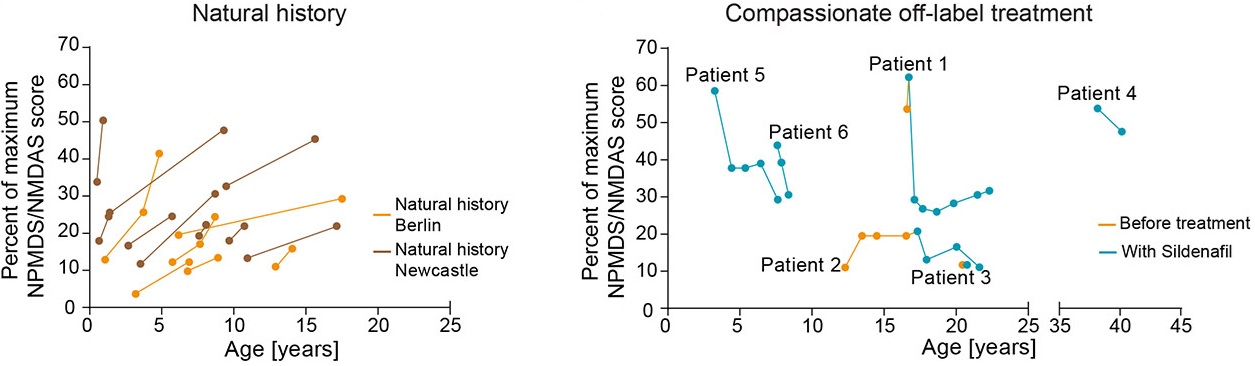
Patients treated with sildenafil experience clear improvements in disease trajectory: ability to move arms and legs, as well as to use a wheelchair is restored. No side effects were recorded (source: Zink et al, Cell 2026).
Technology Description
The approach uses patient-derived iPSCs differentiated into neural progenitor cells to model MILS and screen candidate compounds. Several PDE5 inhibitors were identified in vitro, reverting the defect in mitochondrial membrane potential to normal levels, with a positive influence on intracellular calcium metabolism and cellular growth capacity. Sildenafil was identified and advanced as the lead candidate, and off-label treatments in six affected patients were successfully conducted; treatment was generally well tolerated and showed a remarkably positive therapeutic outcome, including improvement of symptoms and prevention of episodes of metabolic crises. Indeed, one severely affected patient could leave intensive care and return to school.
Commercial Opportunity
We are looking for a co-development/licensing partner for this project with a very high ethical and socio-economic potential.
Development Status
Sildenafil was tested in a small number of MILS patients; clinical validation in a larger cohort is required.
Patent Situation
Two patent applications have been filed: EP4154889A1 pending, priority September 2021; EP4687904A1 pending, originating from PCT WO2024200678A1, priority March 2023.
Further Reading
Zink, A et al. “Pluripotent stem-cell-based screening uncovers sildenafil as a mitochondrial disease therapy.” Cell vol. 189,6 (2026): 1656-1679.e42. doi:10.1016/j.cell.2026.02.008.

Institute of Origin