
ProteasomeID - Quantitative mapping of proteasome interactomes and substrates in vitro and in vivo
Keywords
proteasome, PROTAC, targeted protein degraders, TPD,
undruggable targets
Invention Novelty
Provided is an improved, highly sensitive, and high-throughput compatible screening method for the quantitative mapping of proteins interacting with proteasomes (interactomes) and proteasome substrates readily applicable to virtually any target including low abundant proteins for use in in vitro and in vivo studies. The technique enables the detection of endogenous proteasome substrates as well as substrates that are supplied to the proteasome machinery by the action of a well-characterised PROTAC molecule.
Value Proposition
As the predominant proteolytic machinery, the proteasome system is of central importance for many cellular processes and is associated with various pathologies. Accordingly, the proteasome is a target for new therapeutic approaches. The pool of proteins that are specifically degraded in a particular cell state can therefore provide important information and open up new therapeutic possibilities. Although the therapeutic potential of targeted protein degraders (TPDs) like PROTACs (proteolysis targeting chimera) for the treatment of diseases, especially those driven by yet “un-druggable” targets, is widely recognized, limitations in the investigation of new TPDs like rather slow screening methods hinder drug development. Even the well-established BioID method using BirA* biotin ligase has shortcomings due to ineffective labelling of the highly transient and very brief interactions of the protease. Thus, improved means to identify novel factors or chemicals that influence the recruitment of interaction partners and/or to the proteasome or components thereof, are needed.
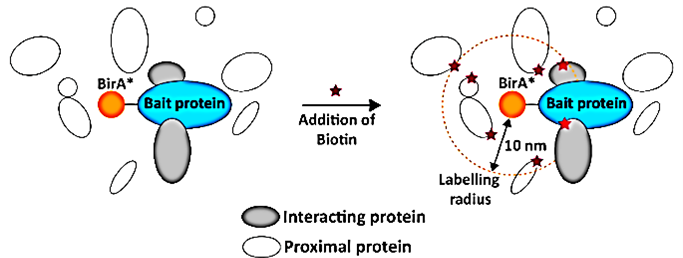
Scheme of ProteasomeID,© Alessandro Ori
Technology Description
The invention relates to an improved method of detecting an interaction or proximity between a fusion protein and a target protein with very high sensitivity, by a) providing a fusion protein or corresponding recombinant nucleic acid molecule, whereby the fusion protein is an enzyme or enzyme complex member fused to a promiscuous biotin ligase, b) inhibiting the enzyme function of the fusion protein or the enzyme complex, c) biotinylating a target protein that interacts with and/or is in proximity to the fusion protein, d) enriching the biotinylated target protein, and identifying the isolated target protein using (quantitative) mass spectrometry (MS). Furthermore, the invention relates to a fusion protein comprising a proteasome complex protein fused to a promiscuous biotin ligase, a cell line and a mouse expressing said fusion protein. The approach is suited for high-throughput screening and preferably involves quantitative measurement techniques, that can be applied to basically any target, including proteins that are only present in small amounts, and in vitro as well as in vivo.
Commercial Opportunity
High-throughput compatible screening tool for direct target validation of protein degraders in vitro and in vivo. The technology is offered for licensing.
Development Status
Proof-of-concept established: Data demonstrating that the method according to the invention can be used to detect both endogenous and protein degrader-induced substrates of the proteasome in cultured cells are available.
Patent Situation
An international patent application was filed in July 2023 (WO2024013381) claiming priority of DE102022117634.7 filed 2022. The application has entered the national phase in Europe and the United States.
Further Reading
Bartolome et.al. 2024: ProteasomeID: quantitative mapping of proteasome interactomes and substrates for in vitro and in vivo studies. eLife 13:RP93256. doi: https://doi.org/10.7554/eLife.93256.2
Licensing Contact

Dr Alejandro Restrepo Arango
Technology ScoutT: +49 531 618120-92
restrepo@ascenion.de
Institute of Origin