Rapid, simultaneous and non-destructive blood diagnostics using a multi-omics NMR platform
Keywords
nuclear magnetic resonance (NMR), glycoproteins, N-glycans, signal selection, diffusion properties, inflammation, heart disesase
Invention Novelty
Acute-phase proteins are common components of blood, whose plasma concentrations alters in response to inflammation and/or infection. They play pivotal roles in the immune response, and serve as biomarkers in clinical diagnostics, aiding in monitoring e.g. disease progression and treatment efficacy. Traditional methods for determining serum concentrations of these proteins, such as ELISA, nephelometry, turbidimetry, HPLC or LC/MS, have limitations. They require individual tests for each protein, are influenced by protein glycosylation, and destructive to the sample. The invention introduces a novel NMR-based approach that overcomes these shortcomings, enabling the simultaneous quantification of multiple proteins based on their glycosylation in a single, swift (10-20 min) measurement. Moreover, the procedure is non-destructive, preserving the sample for potential further testing. In contrast to other methods, sample analysis is more cost-effective and offers comprehensive insights into protein glycosylation; a crucial, yet insufficiently beaconed aspect in comprehending disease mechanisms and formulating targeted therapies.
Value Proposition
The invention holds the potential for a breakthrough improvement in the field. By providing a more detailed and specific analysis of acute-phase proteins and their glycosylation status, it enables a more accurate and comprehensive understanding of inflammatory diseases. This enhances diagnostic accuracy, potentially leading to more effective treatment strategies and improved patient outcomes. The method is particularly suitable for diagnosing a wide range of diseases with an inflammatory component, which exhibit pronounced changes in acute-phase protein glycosylation, as evidenced in cardiovascular disease, rheumatoid arthritis, and MASH. Very robust glycoprotein signatures have been observed in various types of cancer and in neurodegenerative diseases.
Technology Description
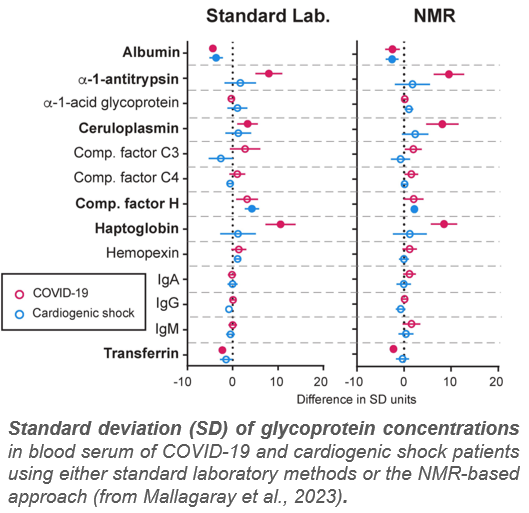
Previous attempts at NMR-based measurement of acute-phase proteins focused on overlapping resonances in 1H-NMR spectra, known as GlycA and GlycB. However, the exact attribution of these NMR signals to specific glycoproteins and glycosylation types remained unknown. The present invention introduces an innovative NMR-based approach that uses diffusion parameters and various specific NMR properties, along with a robust algorithm, to accurately assign signals to specific glycosylation patterns and predict their respective concentrations (see Figure). This reassignment of glycoprotein NMR signals opens new avenues for medical diagnostics and for differentiating patients with various inflammatory diseases from healthy controls.
Commercial Opportunity
The innovation offers a faster, more affordable and comprehensive method for diagnosing and monitoring inflammatory disease, neurodegenerative disorders, and cancer. It can be integrated into existing platforms or developed into a standalone tool. With the rising prevalence of conditions like diabetes, heart disease, and cancer, the demand for a more accurate and thorough diagnostics is set to grow, providing a major market opportunity. The technology is available for in-licensing.
Development Status
The technology is in an advanced stage of development. It has been extensively validated on serum samples from patients suffering from e.g. inflammatory bowel disease, liver carcinoma, Parkinson’s disease. Further validation is underway to evaluate its clinical potential in larger cohorts of patients affected by different inflammatory diseases.
Patent Situation
The German patent DE102023110285.0 has been granted in 2024, and the international application PCT/DE2024/100346 is pending.
Further Reading
Mallagaray et al. (2024) Angew. Chem. Int. Ed. 62: e202306154.
Licensing Contact

Dr Torsten Stachelhaus
Technology ManagerT: +49 40 1888 43 48
stachelhaus@ascenion.de
Institute of Origin