
RNA Sequence Motif for Agonists of the Human Toll-like Receptor 7 (TLR7)
Keywords
Toll-like receptor 7, TLR7, RNA oligonucleotide, immunotherapy, innate immunity, cancer, glioblastoma, vaccine adjuvant
Invention Novelty
Researchers at the Charité – Universitätsmedizin Berlin have identified a minimal, sequence-optimised RNA motif (GAGxUxC(C), e.g. GAGUUUCC) that provides a basis for the development of TLR7 agonists. The synthetic oligonucleotide motif is engineered to induce hTLR7 activation through a newly characterised mechanism involving the dual-protomer dimerisation of the receptor: the central uridine-rich core engages the binding site II of the TLR7 protomer, while the specific flanking N- and C-terminal G-A and C nucleotides bind the dimerisation interface by interacting with the ligand-binding domain of the opposite promoter (TLR7*). Simultaneous sequence-specific binding to binding site II and II* of the partner dimers stabilises the dimeric interface between the TLR7 promoters, thereby potently activating hTLR7 and the corresponding innate immunity downstream signalling cascade.
Value Proposition
Existing TLR7 immunotherapeutics face broad expression profiles of TLR7/8, poor pharmacokinetic properties and toxicities associated with systemic administration. In contrast, the sequence-specific binding of this novel mechanism ensures the tight regulation of hTLR7 activation, potentially avoiding the toxic, off-target inflammatory cascades frequently associated with non-specific approaches. Targeting TLR7/8 has emerged as a highly promising strategy in cancer immunotherapy, with agonists having the potential to act as valuable adjuncts to conventional therapies and adjuvants in cancer vaccine platforms. Applications span oncology (glioma, melanoma, hepatocellular carcinoma) and antiviral treatment, offering broad commercial potential.
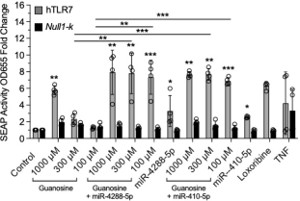
RNA fragments harbouring the minimum motif GAGxUxC are capable of hTLR7 activation. Additional external guanosine synergistically increases the hTLR7 activation response (source: EP26199940.3).
Technology Description
The invention consists of a minimal synthetic RNA oligonucleotide motif that serves as the basis for the development of hTLR7 agonists (GAGxUxC(C)). The oligonucleotide motif binds at the hTLR7 dimerisation interface, stabilising the active dimeric conformation and triggering downstream signalling. Receptor activation causes the TIR domain to recruit MyD88, initiating a pathway that activates NF-κB and AP-1, driving production of pro-inflammatory cytokines, chemokines and type I interferons.
Commercial Opportunity
We are looking for a licensing and/or cooperation partner.
Development Status
In vitro experiments showed the successful activation of TLR7 in receptor-expressing reporter cells using different RNA fragments carrying the specified motif. Next steps include the testing of RNA fragments in glioblastoma in vitro and in vivo models.
Patent Situation
European patent application EP26199940.3 was filed in August 2026.

Institute of Origin