Robust, automatable basophil activation test for routine allergy diagnostics
Keywords
basophil activation, flow cytometry, FcεRIα/CD203c/CD63, gating strategy, automated analysis, quality control, central laboratory, IVD
Invention Novelty
Allergies are among the most common chronic diseases in Western countries. Skin prick tests and serum IgE assays detect sensitization but cannot reliably predict clinical reactivity, so unclear cases often require time-consuming and potentially risky provocation tests. The basophil activation test (BAT) mimics the allergic effector reaction ex vivo and can help distinguish clinically relevant allergy from asymptomatic sensitization. Its routine use, however, has been limited by complex protocols, manual processing, operator-dependent gating and the need for prompt analysis after blood sampling. The invention provides a simplified, robust BAT with a lean marker panel, a defined gating strategy and fully automatable sample processing and data analysis.
Value Proposition
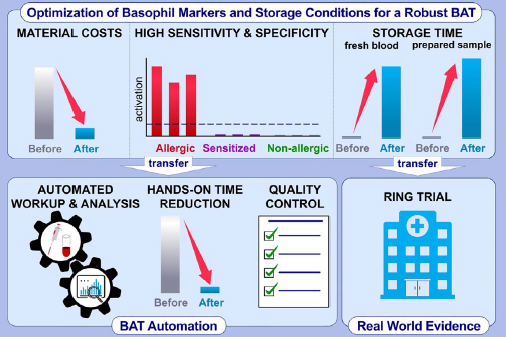
The technology makes BAT-based allergy testing considerably more practicable for routine and central laboratories. The three-antibody panel lowers reagent costs without loss of diagnostic information, while automated 96-well processing and software-based analysis reduce hands-on time and operator dependence. An extended time window between blood sampling and analysis facilitates sample shipment, e.g., from practices and hospitals to specialized laboratories. The method can be transferred to a broad range of standard flow cytometers and provides a standardizable basis for BAT applications, including allergy diagnostics.
(from Behrends et al., 2021).
Technology Description
In the BAT, whole blood is incubated with a suspected allergen. In sensitized individuals, the allergen cross-links specific IgE bound to the high-affinity IgE receptor (FcεRI) on basophils, triggering degranulation and surface exposure of CD63, which is quantified by flow cytometry. Many protocols identify basophils by a single marker such as CCR3, whose expression decreases upon stimulation, so that the gated population may become contaminated with other cells – particularly in the diagnostically relevant stimulated samples. The invention identifies basophils by FcεRIα and CD203c, which are not downregulated upon stimulation, and measures activation via CD63. Bright fluorochromes with low spillover require only two common lasers and no compensation in practice. Gating with doublet exclusion and removal of non-basophil cells yields highly pure basophil populations (≤0.5 % non-basophil cells vs. 20–33 % with a CCR3-based gate). An automated algorithm adjusts the gates for each sample, calculates the proportion of activated basophils and flags technical deviations, such as low basophil counts or elevated background activation.
Commercial Opportunity
The technology is available for licensing and co-development. It is of particular interest to companies in allergy in vitro diagnostics (IVD), flow cytometry and laboratory automation, as well as to specialized diagnostic laboratories.
Development Status
Compared with a 12-antibody reference protocol on more than 1,100 samples from 51 individuals (21 peanut-allergic, 15 peanut-sensitized but tolerant, 15 non-allergic), the three-antibody BAT yielded near-identical activation values (R² = 0.997) and the same diagnostic sensitivity and specificity at 86 % lower reagent costs. Automated analysis was applicable to 99 % of the samples and, in this cohort, achieved a sensitivity of 100 % and a specificity of 97 % for peanut oleosins. Robotic processing gave results comparable to manual preparation and reduced hands-on time for 96 samples from about 9 to 1.5 hours. In time-series experiments, whole blood could be stored for up to 7 days at room temperature or 17 days at 4°C before testing, and prepared samples for up to 28 days at 4°C. A nationwide ring trial with prepared samples shipped uncooled to ten laboratories confirmed the transferability of the method (inter-assay CV 6.7–7.8 %).
Patent Situation
The international application WO2022/038217A1 has entered the national/regional phases in EP and the US.
Further Reading
Behrends et al. (2021) Allergy 76: 3776-3788; and
Jappe et al. (2026) Sci. Rep. 16: 18352.
Licensing Contact

Dr Torsten Stachelhaus
Technology ManagerT: +49 40 1888 43 48
stachelhaus@ascenion.de
Institute of Origin