Self-Organizing Human 2D Neuromuscular Junction Model and 3D Neuromuscular Organoids
Keywords
organoid, neuromuscular, neuromuscular junction, SMA, ALS, myasthenia gravis, spinal muscular atrophy, muscular dystrophy, amyotrophic lateral sclerosis
Invention Novelty
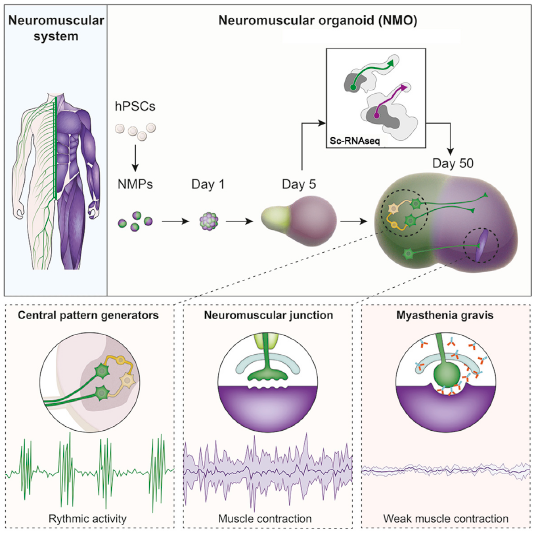
Novel human neuromuscular organoids (NMOs) are provided that can be maintained in 3D culture for several months. HPSC-derived neuromesodermal progenitors (NMP) simultaneously generate spinal cord neurons and skeletal muscle cells that self-organize and generate NMO with functional neuromuscular junctions (NMJ). Self-organization of a neuromuscular junction model can be also achieved as a 2D neuromuscular juction model in a 384 well format.
Value Proposition
The capacity of organoids to generate complex three-dimensional (3D) structures resembling specific organs is transforming the field of biomedicine. While techniques for developing organoids for different single tissues, including the brain, retina, liver, and gut, have advanced in the past decade, it has remained a significant challenge to simultaneously grow two different tissues in a single functional organoid. Such complex organoids are needed to model diseases where more than one tissue is affected, such as neuromuscular diseases. These diseases are caused by functional defects of the nervous system, skeletal muscle, or arise by defects of the NMJ which is a highly organized chemical synapse formed between motor neurons and skeletal muscles. The NMOs presented here generate all components of the NMJ simultaneously which has been a major challenge so far.
Technology Description
The NMOs as well as the 2D NM junction model contain functional NMJ supported by terminal Schwann cells. The NM models contract and develop central pattern generator-like neuronal circuits important for locomotion. As a proof of principle NMOs and 2D NM junction model have been used to model key aspects of spinal muscular atrophy (SMA) and myasthenia gravis pathology, thus highlighting the significant potential of such models for modeling neuromuscular diseases.
Commercial Opportunity
The models are available for collaboration in drug discovery or general studies of neuromuscular diseases.
Development Status
In vitro
Patent Situation
US patent application US 63/050,736 with priority of 10.7.2020 and WO2022008757A1 were filed, pending in US and EP. For the 2D NM junction model patent applications were filed in 2023 in US, CA and SG.
Further Reading
Martins et al. (2020) Cell Stem Cell,Vol. 26, p. 172-186. Self-Organizing 3D Human Trunk Neuromuscular Organoids; DOI: 10.1016/j.stem.2019.12.007
Urzi et al. (2023) Nat. Commun., Vol. 14:8043 "Efficient generation of a self-organizing neuromuscular junction model from human pluripotent stem cells"; https://doi.org/10.1038/s41467-023-43781-3

Institute of Origin