
Spider silk/fibrin implant for the regeneration of injured spinal cord
Keywords
nerve regeneration, neural implant, silk fibers, fibrin sheath, spinal cord repair, peripheral nerve repair
Invention Novelty
The invention introduces a novel neural implant composed of a fibrin sheath containing longitudinally aligned silk fibers, with fibrin filling both the inner volume of the sheath and the spaces between the fibers. This structure provides exceptional mechanical stability for surgical handling and facilitates secure attachment to nerve stumps, enabling effective bridging of nerve defects in both the central and peripheral nervous systems. Uniquely, the implant can be produced without any mammalian cells, growth factors, or hormones, thereby avoiding complex cell culture processes and minimizing potential immune reactions. Additionally, the silk fibers—preferably natural spider silk or fibers spun from natural compounds—offer biocompatibility and guidance for regenerating axons.
Value Proposition
This implant provides an innovative solution for nerve regeneration by combining the natural guidance properties of silk fibers with the supportive, bioactive environment of a fibrin matrix. It addresses a critical unmet medical need by enabling functional recovery in cases where nerve gaps would otherwise prevent reconnection. Its cell-free design reduces manufacturing complexity and costs while extending shelf life in either dry or hydrated storage. The implant’s ability to bridge large nerve defects in both central and peripheral systems expands its potential applications, from spinal cord injury rehabilitation to peripheral nerve repair in traumatic injuries. Furthermore, its customizable structure allows for adaptation to patient-specific anatomical and clinical requirements, enhancing surgical outcomes.
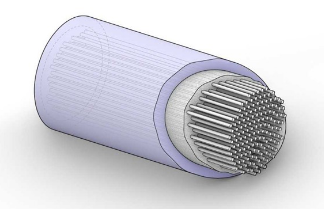
Schematic depiction of the implant. Dense fibrin tube containing longitudinally orientated spider silk held in position by a fibrin filling (Koop et al. 2022)
Technology Description
The implant consists of a fibrin sheath with embedded longitudinal silk fibers, filled with fibrin between the fibers and within the sheath’s lumen. The sheath is formed by polymerizing a fibrinogen solution in a rotating mould to create high-density fibrin with controlled pore sizes (13–80 µm) ideal for nerve cell mitigation and growth, particularly from dorsal root ganglia. The production process allows for either circumferentially closed tubular sheaths or strip-shaped sheaths wound around the fibers. Drying and rehydrating steps enhance tensile strength and mechanical integrity. Silk fibers, either natural spider silk (e.g., Trichonephila edulis, Syn. Nephila edulis) or spun from natural compounds, are arranged to guide nerve regeneration along the implant’s length. Optional incorporation of olfactory ensheathing cells can further promote neural repair.
Commercial Opportunity
The technology is available for co-development or licensing.
Development Status
In vitro and in vivo studies demonstrate that the implant supports neurite migration, neuronal growth, and integration with host tissue, restoring nerve continuity in animal models. The cell-free nature of the product allows for long-term storage and immediate surgical availability, providing a versatile and reliable tool for neurosurgical repair.
Patent Situation
European Patent EP4237024B1 with priority of 2021 has been granted in 2025.
Further Reading
Koop et al. (2022) PLoS One. 2022 Mar 14;17(3):e0264486.doi: 10.1371/journal.pone.0264486.

Institute of Origin