
T-cell therapy of MYD88-L265P-dependent B-cell lymphoma
Keywords
TCR,T-cell therapy,oncology,B-cell lymphoma,MyD88,neoantigen
Challenge
Diffuse large B-cell lymphoma (DLBCL) is characterized by a high degree of genetic heterogeneity. MyD88L265P mutation is a prominent genetic aberration that contributes to tumor growth in this heterogeneous lymphoma entity. It is found in approximately 17% of DLBCL patients and 42% of patients with primary central nervous system lymphoma (PCNSL). While the resulting aberrant scaffold protein represents an attractive therapeutic target, it is difficult to address with conventional pharmacological approaches
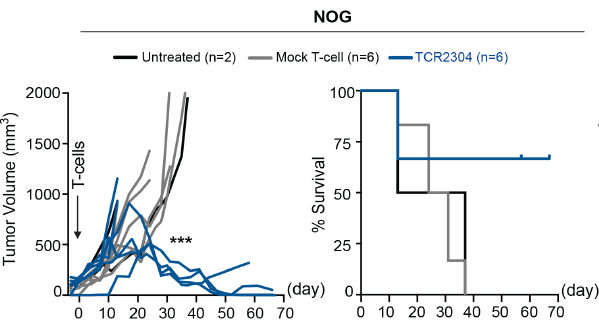
Therapeutic efficacy of TCR-T-cells in a OCI-Ly3 xenograft mouse model (Çınar Ö, et al. J Immunother Cancer 2021).
Technology
Novel human TCRs for targeting the mutant epitope of MyD88L265P have been developed for an adoptive TCR T- cell therapy in HLA-B7 positive patients. This approach offers a novel therapeutic option for patients with relapsed and/or refractory DLBCL and primary CNS lymphoma, enabling patient stratification based on the presence of the somatic MyD88L265P mutation. TCR-redirected T cells selectively recognize and kill target cells presenting the mutant MyD88L265P epitope in an HLA-B7-restricted manner.
This technology provides an opportunity for a straightforward development towards clinical application in a defined patient population.
Commercial Opportunity
TThe technology is available for in-licensing and/or co-development, including clinical translation and further clinical development.
Development Status
Extensive in vitro characterization of multiple TCR candidates has been performed, including analyses of specificity, reactivity, cytotoxicity and safety in various non-Hodgkin lymphoma cell models, complemented by suitable in vivo studies.
A single-arm, multicenter Phase I study in patients with relapsed/refractory (r/r) MyD88L265P-mutated DLBCL, including PCNSL, is planned, with First Patient In targeted for 2026. Patients will receive increasing doses of retrovirally transduced TCR-T cells. The primary endpoints of this first-in-human study are safety and determination of the maximum tolerated dose following a single infusion of TCR-T cells.
Patent Situation
Patent protection granted in CN and the US; patent applications pending in CA and EP (based on WO2020/152161, priority January 2019).
Further Reading
Çinar et al., J Immunother Cancer (2021) 10.1136/jitc-2021-002410
Weber et al., Cancer Immunol Immunother (2018) 10.1007/s00262-018-2242-9

Institute of Origin