
Two-Dimensional Redundant Dual Barcoding for Ultra-High-Throughput, Error-Resilient Nucleic Acid Analysis
Keywords
dual barcoding,two-step amplification-indexing,next-generation & high-throughput sequencing,error correction,multiplexing
Invention Novelty
The invention introduces a fundamentally novel approach to multiplexed nucleic acid sequencing by integrating sample-specific barcoding across two independent amplification stages, creating a two-dimensional redundant indexing system. Unlike traditional library-prep-only indexing methods (e.g., Illumina UDI), this approach appends unique dual indices first during a high-cycle amplification step and again during a limited-cycle indexing step. As a result, each amplicon carries four independent barcodes that must all match for confident sample assignment, enabling exponential error suppression and perfect sample recall at unpre-cedented scales (36,864+ samples per run). The barcode sets are designed with optimized Hamming distances and incorporate stringent carryover-suppression measures (UDG/UTP treatment, ExoProStar cleanup, limited-cycle indexing), eliminating index hopping and recombination artifacts inherent to single-layer systems. Importantly, while PCR is the preferred amplification method, the technology is also compatible with alternative techniques such as isothermal amplification (e.g., LAMP, RPA), provided they meet the required sensitivity and specificity thresholds. The technology is also platform- and target-agnostic, i.e., the barcode architecture and universal priming principles are compatible with all sequencing chemistries and any type of nucleic acid analyte.
Value Proposition
The dual-barcoding platform offers four key advantages for sequencing labs and kit manufacturers. First, it cuts per-sample costs by >40% by replacing adapter ligation kits with standard amplification workflows, eliminating premium reagents. Second, its two-dimensional combinatorial indexing enables multiplexing of 36,864+ samples per run, far surpassing conventional throughput limits (e.g., Illumina: 1,300 samples; Nanopore 1,800 samples), and enabling true population-scale studies. Third, redundant dual-layer indexing verifies sample identity, dramatically lowering error rates and crosstalk for clinical-grade data integrity and simplified quality control. Fourth, redundancy creates an automated audit trail, streamlining regulatory submissions and companion diagnostic integration. For platform manufacturers, these features unlock new applications in e.g. infectious disease surveillance, oncology biomarker screening, and population genomics across diverse sequencing technologies. Service providers gain cost savings, high throughput, and improved regulatory compliance, regardless of the amplification method used (PCR, LAMP, RPA, or others).
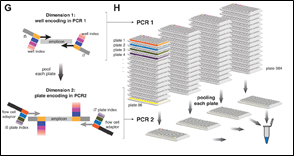
The NGS-based detection pipeline uses unique dual barcodes in PCR1 and specific dual barcodes in PCR2, enabling the simultaneous analysis of amplicons from thousands of samples within a single, rapid sequencing run (Yelagandula et al., 2021).
Technology Description
The two-step amplification barcoding system uses sequential amplification to enable ultra-high multiplexing. In the first high-cycle amplification step, target nucleic acids are amplified with specific dual indices and universal priming sites, equalizing sample input for balanced read distribution. The second limited-cycle indexing step then adds layer-specific dual indices and sequencing adapters with minimal cycles to reduce artifacts and recombination risk. Sequencing reads are validated only if all four indices – two from the first, two from the second amplification step – match legitimate barcode pairs. Index sets are Hamming-optimized for robust error correction at typical sequencing error rates. This architecture is compatible with any dual-end sequencing platform (Illumina, Nanopore, BGI/MGI) and adaptable to any target chemistry. The result is combinatorial sample identification at scales of 36,864 (96×384) or more, with near-perfect specificity and crosstalk below 0.01%, as demonstrated in large clinical studies.
Commercial Opportunity
The technology is comprehensively validated and robustly protected, offering a unique opportunity to achieve or maintain market leadership in next-generation ultra-high-throughput sequencing. Its effectiveness has been proven on a large scale, as it enabled population-wide surveillance throughout Austria during the SARS-CoV-2 pandemic.
Development Status
Validation experiments have confirmed the technology’s core strengths: effective combinatorial dual indexing at scales exceeding 18,000 samples per run, with rigorous error suppression and sensitivity on par with gold-standard RT-qPCR. Automation compatibility with standard liquid hand-ling and sequencing instruments is established, and the software pipeline is thoroughly tested and publicly available. With a technology maturity level of TRL 7–8, the platform is ready for commercial deployment.
Patent Situation
Based on WO2022/084295A1, the EP patent has been granted and national applications in the US and China are pending.
Further Reading
Yelagandula et al. (2021) Nat. Commun. 12: 3132-3248.
Licensing Contact

Dr Torsten Stachelhaus
Technology ManagerT: +49 40 1888 43 48
stachelhaus@ascenion.de
Institute of Origin