
VSV-encoded HCV vaccines that induce broadly neutralising antibodies against Hepatitis C
Invention Novelty
Due to the extraordinary diversity and flexibility of Hepatitis C Virus (HCV) as well as different immune evasion mechanisms, HCV is a difficult target for vaccine development. Making use of a newly established virus reference panel scientists of TWINCORE – Centre for Experimental and Clinical Infection Research and University of Bern identified a set of E1E2 envelope variants, that encoded in Vesicular Stomatitis Virus (VSV)-based vaccine vectors induce neutralizing antibodies that cross-bind a broad spectrum of HCV biotypes.
Value Proposition
Despite the availability of effective direct-acting antiviral therapy, the worldwide incidence of HCV infections remains high. Only a prophylactic vaccine has the capability to significantly lower the number of cases and break the cycle of transmission after undiagnosed infection, post-therapy reinfection, and drug resistance. According to WHO about 1.5 million people are infected with HCV per year, leading to 290.00 yearly deaths mainly due to liver cancer and cirrhosis. About 70% of patients exposed to HCV develop a chronic infection that without successful treatment ultimately may lead to the need of liver transplantation. The newly generated rVSV-HCV particles can be developed as a stand-alone vaccine or as part of a prime-boost protocol.
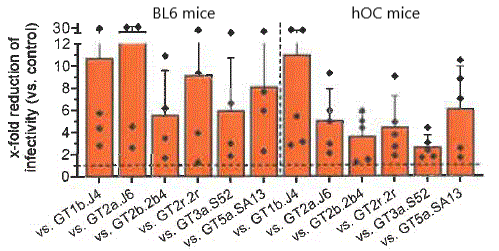
Sera of GT2a.J6 immunized mice contain cross-neutralizing antibodies against a broad spectrum of HCV biotypes.
Technology Description
E1E2 envelope sequences of representatives of the 6 formerly identified HCV biotypes have been inserted into G protein-deleted VSV-based vaccine vectors (rVSV-HCV). By applying vector-independent protein G during rVSV-HCV production, high-titer pseudovirus particles that include functional E1E2 as well as G protein in their envelopes are generated. Due to the broad tropism of VSV-G the particles are capable to infect a large variety of cell types. Infected cells after a subsequent replication round release pseudovirus particles that present HCV-E1E2 only. While post-vaccination analysis showed that sera of all immunized mice contain HCV-E1E2 binding antibodies, only a subset of antigens induce neutralizing antibodies against all HCV biotypes.
Commercial Opportunity
The technology is available for licensing and co-development.
Development Status
Generation of HCV E1E2 binding antibodies has been confirmed in sera of all immunized mice by quantitative ELISA against E1E2 envelope proteins of 13 reference viruses of 6 HCV biotypes. Selection of superior vaccine candidates for further development has been performed by comparative analysis of in vivo Induction of cross-neutralizing antibodies against 6 HCV biotypes in a neutralization assay.
Patent Situation
Applications based on WO2024/003343A1 with priority of 2022 have been granted in Europe and Eurasia, are pending in China, India, USA.
Further Reading
Bankwitz et al. (2021) Hepatitis C reference viruses highlight potent antibody responses and diverse viral functional interactions with neutralising antibodies. Gut. 2021 Sep;70(9):1734-1745.

Institute of Origin