
EPA01: ENGINEERED SERINE INTEGRASE FOR TARGETED LARGE-PAYLOAD GENE TRANSFER
Keywords
serine integrase, gene therapy, genome editing, gene transfer, ATMP
Invention Novelty
Researchers of Charité developed an engineered serine integrase (ePa01) that enables efficient, site-specific insertion of large DNA payloads into the genome of primary human cells. Combined with the one-pot PASTA (Programmable And Site-specific Transgene Addition) workflow, it allows non-viral integration of large, multigenic transgenes at defined loci in a single transfection step.
Value Proposition
Genome editing tools like CRISPR-Cas are revolutionary but have limitations in transferring large genetic information. Next-generation cell therapies increasingly require large, multigenic payloads, e.g. multiple CARs, safety switches or cytokine support, that exceed the capacity of HDR-based knock-in and viral vectors. One-pot PASTA with ePa01 addresses this need. It enables precise, non-viral insertion of large transgenes at clinically relevant loci, overcomes the size limitations of viral systems and reduces the costs and timelines associated with GMP-grade viruses. Beyond therapeutic applications, the technology is suited as a research tool and for complex cell line engineering.
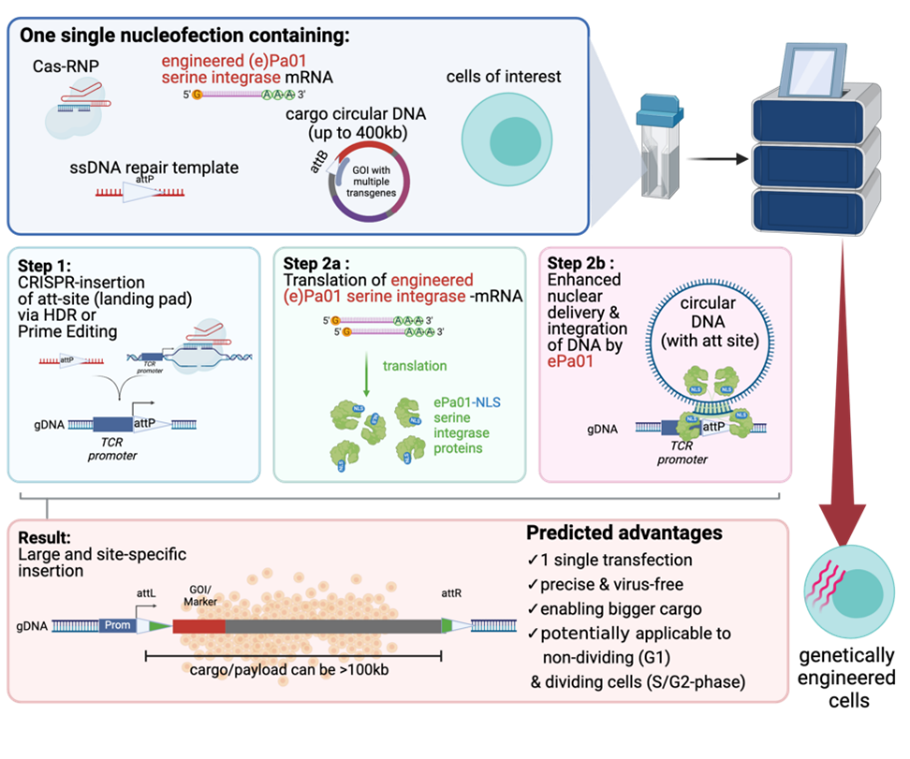
Fig. 1 Improving non-viral tools for larger transgenes and potentially independence of HDR (provided by Wagner Lab)
Technology Description
In one-pot PASTA, four components are delivered in a single transfection: a Cas RNP and an HDR template install an att "landing pad" at a predefined locus, while the integrase mediates insertion of a circular donor DNA carrying the payload at this site. The proprietary integrase ePa01 is based on Pa01, which was prioritized for its specificity, and is engineered with two C-terminal nucleoplasmin nuclear localization signals (NLS). These improve nuclear delivery and recombination activity. ePa01 outperforms both the parental Pa01 and the benchmark Bxb1. In primary human T cells, one-pot PASTA achieved integration in 29–44% of cells. For a 6.5 kb transgene it was on average 19-fold more efficient than conventional HDR and about 5-fold more efficient than PASSIGE. Integration of constructs up to 10.5 kb was demonstrated, with an average of about 1.2 transgene copies per edited cell. As application functional dual CD19/CD20 CAR T cells were generated (Fig. 1).
Commercial Opportunity
In-licensing or collaboration for further development.
Development Status
Preclinical proof of concept has been established. Ongoing work focuses on further de-risking the platform, including optimized donor DNA formats and the characterization of integration specificity.
Patent Situation
WO2026046974A1, priority July 2026; Kassing et al.: Versatile and efficient non-viral integration of large transgenes in human T cells via CRISPR knock-in and engineered integrases, bioRxiv 2025; doi: doi.org/10.1101/2025.09.10.675267.
Further Reading
Yarnall MTN, et al., Drag-and-drop genome insertion of large sequences without double-strand DNA cleavage using CRISPR-directed integrases. Nat Biotechnol. 2023 Apr;41(4):500-512. doi: 10.1038/s41587-022-01527-4.
Licensing Contact

Dr Céline Christiansen-Mensch
Technology ManagerT: +49 (0)1590 4836722
christiansen@ascenion.de
Institute of Origin