
An engineered serine integrase for targeted gene transfer in human cells
Keywords
serine integrase, gene therapy, genome editing, gene transfer, ATMP
Invention Novelty
Researchers of Charité developed a novel gene editing technology that utilizes an engineered serine integrase to enable insertion of DNA fragments of up to 100 kilobases (kb) in length into the genome of the target cell in a sequence-specific manner and with a high integration frequency.
Value Proposition
Genome editing tools like CRISPR-Cas are revolutionary but have limitations in transferring large genetic information. The new serine integrase variant can serve as a powerful tool to develop advanced cell and gene therapies that require large cargo delivery, but also other biotechnology solutions such as cell line engineering. This method overcomes the size limitations of viral systems and reduces costs associated with GMP-grade viruses, offering a promising alternative for precise, site-specific integration of large cargo.
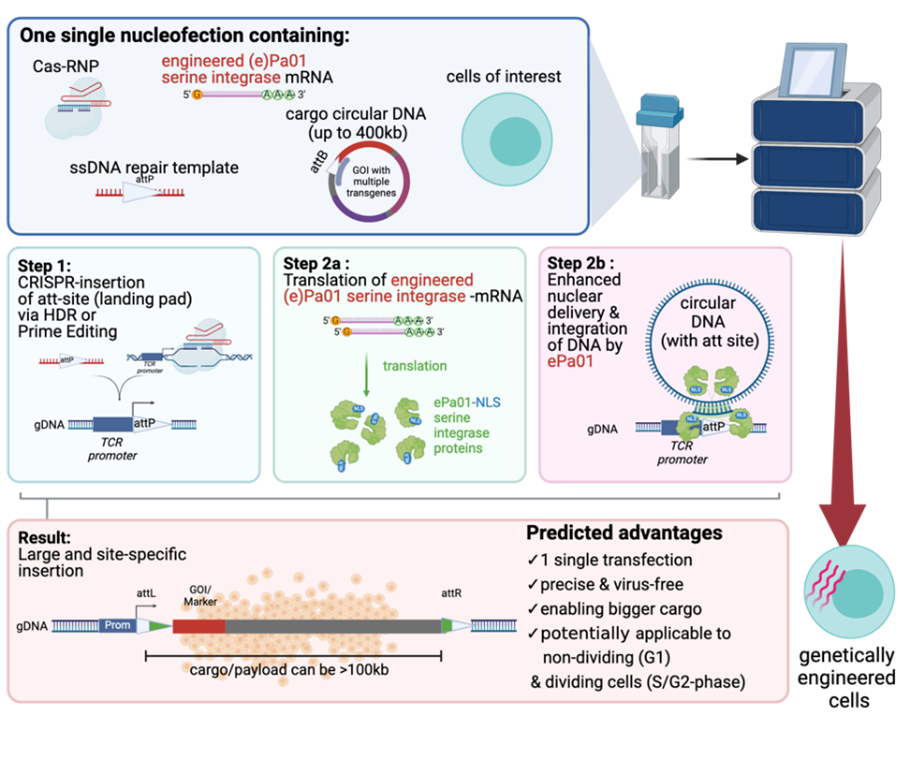
Fig. 1 Improving non-viral tools for larger transgenes and potentially independence of HDR (provided by Wagner Lab)
Technology Description
Large serine-integrases (LSR), derived from bacteriophages, catalyze specific recombination events by precisely inserting DNA fragments at defined locations in the genome through specific attachment (att) sites, or "landing pads", which are inserted into the genome in a previous gene editing step using prime editing or CRISPR-Cas enzymes. The new approach involves the engineering of a large serine integrase, Pa01, to enhance sequence-specific recombination in primary human cells. This is achieved by fusing a nuclear localization sequence (NLS) to the C-terminal end of the integrase, significantly improving its ability to insert DNA into the human T cell genome. The newly developed LSR variant has demonstrated superior performance compared to the current standard, Bxb1, indicating its potential as an innovative tool in gene therapy. The non-viral system provides high flexibility with improved recombination efficacy through the engineered (e)Pa01 LSR. Herein, ePa01 contributes to improved nuclear delivery of itself and the DNA cargo into the nucleus. It may be used to redirect primary human cell types, both ex vivo and in vivo.
Commercial Opportunity
In-licensing or collaboration for further development.
Development Status
Initial proof-of-concept studies have been performed at Charité – Berlin University Medicine.
Patent Situation
A European priority application was filed in July 2024.
Further Reading
Yarnall MTN, et al., Drag-and-drop genome insertion of large sequences without double-strand DNA cleavage using CRISPR-directed integrases. Nat Biotechnol. 2023 Apr;41(4):500-512. doi: 10.1038/s41587-022-01527-4.
Licensing Contact

Dr Céline Christiansen-Mensch
Technology ManagerT: +49 (0)1590 4836722
christiansen@ascenion.de
Institute of Origin