Gene editing of the proteinase 3 autoantigen as a novel treatment for ANCA-associated vasculitis
Keywords
anti-neutrophil cytoplasmic autoantibody,PR3,hematopoietic stem cells,gene editing,autoimmune disease,rare disease,vasculitis
Invention Novelty
The technology provides a novel approach for treating proteinase 3 (PR3)-specific anti-neutrophil cytoplasm antibody (ANCA)-associated vasculitis (AAV) via an autologous cell therapy. AAV are severe, systemic autoimmune diseases causing inflammation of small blood vessels. Triggered by autoantibodies against PR3 or myeloperoxidase (MPO) on neutrophils and monocytes, it leads to cell overactivation and, if untreated, can cause multi-organ damage and death within months.
Value Proposition
Unlike conventional treatments that suppress the immune system non-specifically and are often associated with disease relapses, this innovative approach precisely targets the molecular disease trigger PR3. The approach deletes the PR3 autoantigen thereby avoiding long-term immunosuppression that is associated with treatment-associated morbidity and mortality. This novel strategy offers a potentially curative alternative aimed at achieving long-term, drug-free remission - particularly valuable for patients with refractory or relapsing disease. The strategy developed by scientists at Charité and the Max Delbrück Center involves ex vivo gene editing of CD34+ hematopoietic stem and progenitor cells (HSPCs) of the PR3-AAV patient, which could then be reintroduced to regenerate a neutrophil population devoid of the pathogenic PR3 autoantigen.
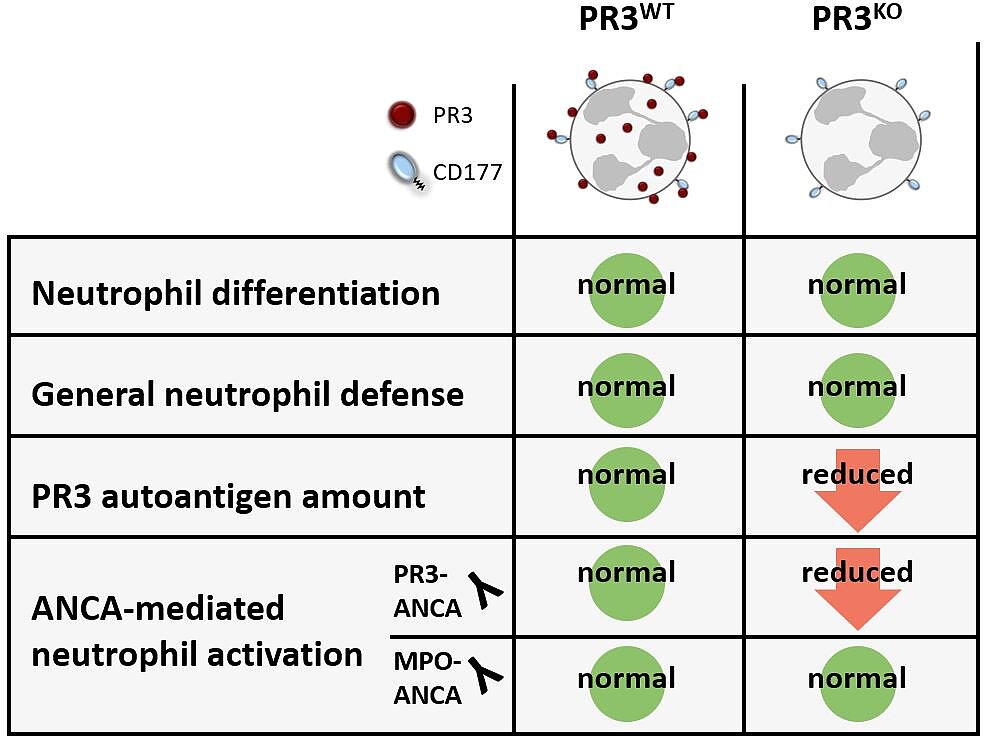
Effects of PR3 gene editing in HSPC-derived neutrophils. Source: Jerke et al., Kidney Int. 2025
Technology Description
Human HSPCs were edited using a ribonucleoprotein (RNP) complex composed of Cas9 and a single-guide RNA targeting the PRTN3 gene. Editing leads to effective elimination of PR3 protein expression and abrogation of PR3 enzymatic activity in differentiated neutrophils. Experimental results demonstrate that PR3-knockout (PR3KO) HSPCs maintain a normal developmental behavior, and in vitro differentiated neutrophils were not impaired in viability and functionality, including phagocytosis, oxidative burst, degranulation, and constitutive apoptosis. Importantly, PR3KO neutrophils exhibit highly diminished PR3-ANCA binding and show a significantly reduced activation response to PR3-ANCA antibodies, while MPO-ANCA stimulation was not affected. The treatment concept involves autologous transplantation of the ex vivo edited HSPCs following conditioning, with the aim of generating a neutrophil population devoid of the pathogenic PR3 autoantigen.
Commercial Opportunity
The technology is available for licensing and/or co-development, including clinical translation.
Development Status
In vitro proof-of-concept established. Off-target analysis is ongoing, with no off-target editing confirmed at 40 candidate sites tested to date. In vivo validation in an NSG mouse model and further advanced off-target analyses are planned.
Patent Situation
International patent application WO2026068651A1 published; priority: September 2024.
Further Reading
Jerke et al., Kidney Int. 2025, DOI: 10.1016/j.kint.2025.03.020

Institute of Origin